

Genomics Market to reach USD 84.30 Billion by 2035 at 10.8% CAGR
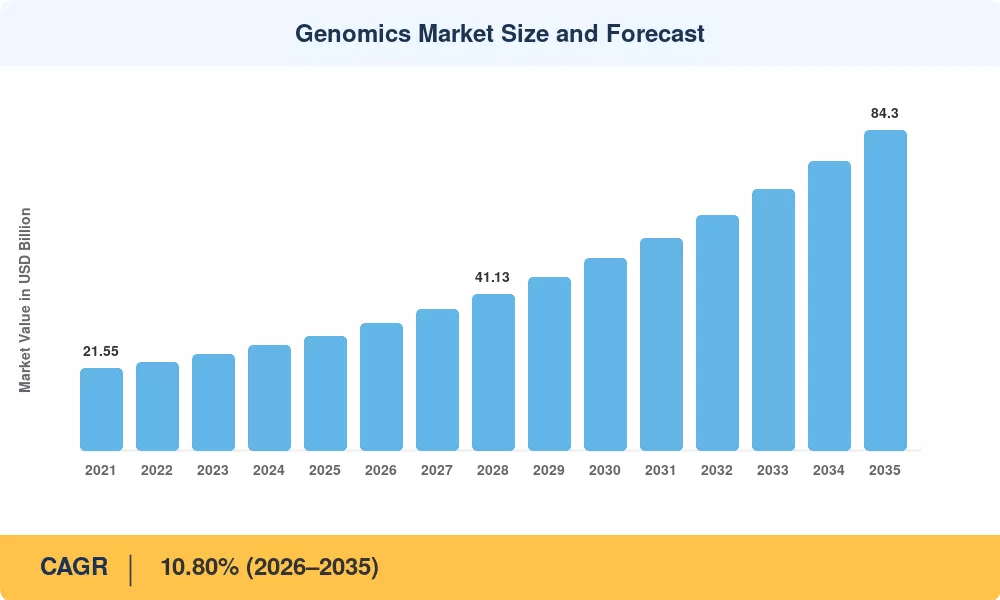
Genomics Market Size
Genomics Market to Surge from USD 33.50 Billion in 2026 to USD 84.30 Billion by 2035---Powered by National Mega-Genome Programmes, Declining Sequencing Costs
NY, CA, UNITED STATES, July 6, 2026 /EINPresswire.com/ -- As per Market Research Future, the global Genomics Market size to reach USD 84.30 Billion by 2035 from USD 33.50 Billion in 2026, at a CAGR of 10.8% during the forecast period 2026--2035. The market base was estimated at USD 30.15 Billion in 2025.The 10.8% CAGR---anchored by structural demand for precision and preventive healthcare rather than discretionary spending---is driven by three converging forces: national mega-genome programmes that continue to widen the addressable sample base for genomic sequencing and profiling, sustained decline in per-genome sequencing costs that has pulled genetic analysis from specialized research luxury into accessible high-volume clinical tool, and broader reimbursement frameworks that have converted genomic testing from out-of-pocket expense into standard-of-care reimbursement priority tied to companion diagnostics and pharmacogenomic prescribing.
National governments and multilateral health organizations are amplifying this momentum. The UK's Genomics England programme now targets five million whole genomes by 2028. Because the cost to sequence a full human genome has plummeted below USD 200---a scaling reduction exceeding 99.999% compared to the original Human Genome Project's landmark USD 2.7 billion budget---this demographic and cost wave mechanically expands the addressable population for clinical genomic screening.
Request A Free Sample:
https://www.marketresearchfuture.com/sample_request/12283
Key Market Trends & Growth Drivers
National Mega-Genome Programmes and Population-Scale Sequencing
Government population genomics projects span over 25 nations. The UK Biobank provides open research access to whole genome sequencing datasets for all 500,000 participants, alongside 470,000 whole exomes. The UK's Genomics England programme now targets five million whole genomes by 2028, creating a sustained demand pipeline for sequencing consumables, instruments, and bioinformatics services. China's National Genomics Data Center maintains a massive 108-petabyte storage architecture, underpinning the world's largest sequencing capacity through BGI Group. These long-term public programs secure foundational equipment procurement, de-risking manufacturer capacity pipelines.
The 1+ Million Genomes initiative, spanning 24 EU member states, coordinates federated data access that enables pan-European clinical trials and positions the region as a durable pillar of the Genomics Market. India's Genome India Project completed whole-genome sequencing for 10,074 individuals across 99 distinct communities, archived at the Indian Biological Data Centre. Saudi Arabia's Genome Project aims to sequence 100,000 genomes, creating a pharmacogenomic reference for the Arabian Peninsula population. Each national programme expansion translates into measurable instrument and consumable procurement volume, and the embedded sequencing schedule within routine healthcare systems makes this driver structurally durable through 2035.
Declining Sequencing Costs and Clinical Democratization
The financial threshold to sequence a full human genome has plummeted below USD 200, representing a scaling reduction exceeding 99.999% compared to the original Human Genome Project's landmark USD 2.7 billion budget. This deflation transitions genetic sequencing from a specialized research luxury into an accessible, high-volume clinical tool for hospital labs globally. High-throughput short-read and long-read sequencers are replacing legacy Sanger capillary devices and low-throughput microarray platforms, fundamentally changing how laboratories handle biological data.
Target systems capable of at least 300 GB per run now handle oncology panels, pharmacogenomics, and rare-disease exomes without batching delays, keeping cost-per-sample below USD 350 for most clinical panels. Early-adopter health systems report that AI-enhanced variant interpretation platforms reduce diagnostic turnaround times by 40--60%, converting patients who would previously have faced months of uncertainty into candidates for timely precision therapy.
Broader Reimbursement Frameworks and Value-Based Genomics
The Centers for Medicare & Medicaid Services established standard national coverage for advanced next-generation sequencing across solid tumors in 2018, expanding germline pathways in 2020. France's national initiative deployed EUR 239 million to integrate its primary high-throughput sequencing platforms, translating latent demand into regular health system reimbursed clinical procedures. Canada's Genome Canada organization disbursed CAD 280 million in genomics research grants during 2023--2025, while Mexico's National Institute of Genomic Medicine is building population-reference panels that will underpin future clinical deployments.
Several U.S. health systems now require pharmacogenomic testing before prescribing high-risk drugs such as clopidogrel and codeine. The Clinical Pharmacogenetics Implementation Consortium has published guidelines for over 100 drug--gene pairs, and electronic health record integration makes pre-emptive panel testing operationally feasible.
Ask for Customization:
https://www.marketresearchfuture.com/ask_for_customize/12283
Market Segment Insights
BY PRODUCT & SERVICES
Consumables: Dominant segment with ~53.8% revenue share in 2025. Including reagents, kits, and library-preparation chemistries---reflecting their recurring-revenue nature. Every sequencing run requires fresh reagents, flow cells, and library-preparation kits, creating a razor-and-blade dynamic that locks in recurring spending. Illumina's sequencing-by-synthesis chemistry and its competitors' alternative chemistries generate high-margin consumable revenue that typically exceeds instrument sales by a factor of three to four over an instrument's lifecycle.
Instruments & Systems: Fastest-growing product segment at 13.0% CAGR (2026--2035). Driven by hospital on-premises installation mandates to meet data-residency requirements. Data-residency regulations in the EU, China, and parts of Southeast Asia require that patient genomic data remain within national borders, compelling institutions to acquire benchtop and production-scale sequencers rather than relying on overseas reference laboratories.
BY TECHNOLOGY
Sequencing: Dominant technology with ~36.7% revenue share in 2025. Both short-read and long-read architectures expanding their clinical utility. Sequencing holds the largest technology share, encompassing high-throughput short-read platforms for population-scale projects and long-read systems that resolve complex structural variants.
Long-Read and Single-Molecule Technologies: Fastest-growing technology segment at 12.8% CAGR (2026--2035). Driven by structural-variant detection for gene-therapy pipelines. Long-read single-molecule technologies are advancing as accuracy improvements surpass 99%, unlocking clinical applications in gene-therapy characterization and repeat-expansion disorder testing.
BY APPLICATION
Diagnostics: Dominant application with ~32.4% revenue share in 2025. Led by oncology panels and non-invasive prenatal testing. Diagnostics commands the largest application share because regulatory approvals and reimbursement codes create a reliable demand floor.
Precision & Personalized Medicine: Fastest-growing application segment at 13.1% CAGR (2026--2035). Propelled by growing evidence that pharmacogenomic-guided prescribing reduces adverse drug events by 20--30% and improves therapeutic outcomes.
Drug Discovery & Development: USD 6.85 Billion in 2025. Target identification and biomarker-driven trials anchor this segment.
BY END USER
Diagnostic & Reference Laboratories: Largest segment with ~36.8% share in 2025. High throughput and broad test menus dominate volume. Diagnostic and reference laboratories lead by consolidating high specimen volumes that justify capital-intensive instrument installations.
Pharmaceutical & Biotechnology Companies: Fastest-growing end-user segment at 11.7% CAGR (2026--2035). Driven by regulatory expectations that oncology drug submissions include companion diagnostic biomarker data.
Read Detailed Insights:
https://www.marketresearchfuture.com/reports/genomics-market-12283
Regional Outlook
North America -- Dominant Market (~38.5% Share, 2025)
The United States generates approximately 78.2% of North American Genomics Market revenue, driven by Medicare coverage for comprehensive genomic profiling, commercial insurance reimbursement for next-generation sequencing across solid tumors, and the NIH's commitment of more than USD 1.5 billion to the All of Us Research Program---a single policy ecosystem that converted a research-dominated market into one with a structural clinical sequencing tail. CMS national coverage determinations for advanced next-generation sequencing have driven adoption across over 4,000 CLIA-certified laboratories, while community oncology networks increasingly prescribe pharmacogenomic panel testing to guide therapeutic decision-making. The US dominates through a combination of high per-patient spending, robust payer coverage, and rapid adoption of AI-driven variant interpretation platforms.
Europe -- Second Largest (USD 8.14 Billion, 2025)
Europe's Genomics Market reflects divergent national strategies---the UK leads regionally with Genomics England and the NHS Genomic Medicine Service, contributing USD 2.18 Billion in 2025, while Germany historically used selective molecular diagnostics targeting before broadening coverage through DKFZ programs at 11.8% CAGR. France contributes ~14.2% of regional share through Plan France Medecine Genomique investment. Italy contributes 9.8% of regional share on National Center for Gene Therapy trials. Spain is growing at steady pace on the IMPaCT-Genomica initiative at 7.5% of regional share.
Asia-Pacific -- Fastest-Growing Region (13.0% CAGR, 2026--2035)
Asia-Pacific is the engine of the Genomics Market. China holds the largest regional share with ~34.5% of regional revenue, driven by CNCB data centers and the BGI manufacturing ecosystem---instantly creating the world's largest sequencing capacity. India is growing at 12.6% CAGR on the back of the Genome India Project and growing IVD manufacturing. Japan contributes 19.2% of regional share through AMED precision medicine programs at steady pace. South Korea is growing at steady pace on the K-Genome Project and Samsung Genome Institute at 13.8% of regional share.
Middle East & Africa -- Emerging Opportunity (USD 1.36 Billion, 2025)
The Middle East & Africa is bifurcated between well-funded Gulf states and resource-constrained Sub-Saharan nations. Saudi Arabia leads the region with the Saudi Genome Project and Vision 2030 health investment, contributing ~32.0% of regional share---the NEOM health cluster and the UAE's Dubai Genomics Center have created pockets of excellence for genomic medicine. The UAE is growing at steady pace on medical tourism for precision diagnostics at 24.5% of regional share. South Africa contributes 18.0% of regional share on H3Africa Consortium participation.
South America -- Growing Presence (USD 1.66 Billion, 2025)
Brazil anchors South America's Genomics Market at ~58.0% of regional revenue, with the FAPESP Genome Program and oncology-panel adoption providing a stable demand floor that smooths regional forecasts. Access to advanced sequencing remains limited by import dependencies, though regional laboratory networks are expanding. Argentina is growing at 11.2% CAGR on university-led sequencing collaborations.
Competitive Landscape and Recent Developments
The Genomics Market exhibits medium concentration, with the top five companies collectively controlling an estimated 50--58% of global revenue. Illumina maintains the largest share through its installed base of short-read sequencers, but competitive intensity is rising as long-read and nanopore entrants erode platform lock-in. Mergers, licensing deals, and vertical integration into bioinformatics software characterize the strategic posture of leading players.
The competitive landscape is stratified between short-read sequencing platform leaders serving global clinical and research markets, long-read and nanopore specialists capturing structural variant detection demand, and bioinformatics software developers consolidating the interpretation and reporting segment.
KEY COMPANIES AND RECENT MILESTONES
Illumina (2024--2025): Maintains leadership with NovaSeq X, NextSeq, and TruSight oncology panels, commanding ~18--22% of global Genomics Market revenue. Dominant short-read platform with a global installed base. Premium instrument positioning in high-throughput segments offsets competitive pressure from emerging long-read platforms.
Thermo Fisher Scientific (2024--2025): Broad life-science portfolio with Ion Torrent, Applied Biosystems, and Oncomine platforms reinforces the clinical diagnostics integration positioning, holding ~10--14% of global revenue.
Roche (June 2026): Launched AXELIOS 1, a single-molecule next-generation sequencing platform using proprietary Sequencing by Expansion technology to deliver same-day whole-genome research results. Oncology-focused companion diagnostics integration anchors a strong global franchise, holding ~6--9% of global revenue.
Future Outlook: 2026--2035
By 2030, precision multi-omic theranostics will become the operating system of genomic medicine. The convergence of companion diagnostics, pharmacogenomic prescribing, and AI-driven variant interpretation will reshape the Genomics Market through the late 2020s. By 2030, an estimated 40% of newly diagnosed cancer patients will undergo comprehensive genomic profiling followed by matched targeted therapy, creating a diagnostic-therapeutic revenue loop. The NIH's USD 1.5 billion All of Us investment ensures domestic sequencing infrastructure scales alongside clinical demand. Machine-learning models that integrate genomic, proteomic, and metabolomic data can recommend optimal therapeutic regimens for individual patients. Start-ups have raised over USD 800 million in venture funding for AI-driven genomics decision-support tools since 2023.
Cloud-based access expansion and AI-integrated clinical decision support will reframe cost structures by the early 2030s. Core short-read chemistry patents held by Illumina have begun expiring, opening space for compatible reagent suppliers and potentially reducing consumable costs by 20--30%. While this compresses per-unit revenue, volume expansion---particularly in Asia-Pacific and South America---is projected to more than offset pricing headwinds. The net effect accelerates Genomics Market penetration in markets where out-of-pocket costs currently limit clinical sequencing initiation. AI-integrated clinical decision support platforms will guide optimal pharmacogenomic prescribing and therapeutic sequencing by 2028--2030. ASCO and ESMO are developing clinical-decision-support frameworks that embed AI recommendations into electronic health records, standardizing genomic testing initiation criteria across practice settings.
More Related Research Insights:
https://www.marketresearchfuture.com/reports/leuprolide-acetate-market-785
https://www.marketresearchfuture.com/reports/gene-panel-market-6100
https://www.marketresearchfuture.com/reports/laboratory-chemicals-market-923
https://www.marketresearchfuture.com/reports/infrared-thermometer-market-9771
https://www.marketresearchfuture.com/reports/heart-attack-diagnostics-market-22429
https://www.marketresearchfuture.com/reports/hairy-cell-leukemia-market-29533
https://www.marketresearchfuture.com/reports/gel-documentation-systems-market-6908
https://www.marketresearchfuture.com/reports/industrial-microbiology-market-43161
https://www.marketresearchfuture.com/reports/poultry-diagnostics-market-29413
https://www.marketresearchfuture.com/reports/oligonucleotide-synthesis-market-2337
Larry Wilson
WantStats Research And Media Pvt. Ltd.
+1 855-661-4441
email us here
Visit us on social media:
LinkedIn
Facebook
YouTube
X
Legal Disclaimer:
EIN Presswire provides this news content "as is" without warranty of any kind. We do not accept any responsibility or liability for the accuracy, content, images, videos, licenses, completeness, legality, or reliability of the information contained in this article. If you have any complaints or copyright issues related to this article, kindly contact the author above.
