

The narrowing of the euro area current account balance in 2025
Prepared by Lorenz Emter, Michael Fidora, Fausto Pastoris and Martin Schmitz
Published as part of the ECB Economic Bulletin, Issue 4/2026.
The euro area current account surplus narrowed markedly in 2025 under the impact of US trade tariffs, the activities of US multinational enterprises (MNEs), structural shifts in global trade in goods, and rising digital and artificial intelligence (AI)-related investment. The surplus declined to 1.7% of GDP in 2025, from 2.7% in 2024 (Chart A). Excluding the period 2022-2023, which was marked by the energy shock following Russia’s full-scale invasion of Ukraine, this was the lowest surplus since 2012, when the euro area current account balance moved from a deficit to a surplus in the wake of the sovereign debt crisis.[1] This box examines the main drivers of the narrowing of the euro area current account surplus in 2025.
Chart A
Euro area current account balance and components
(percentages of GDP)

Source: ECB.
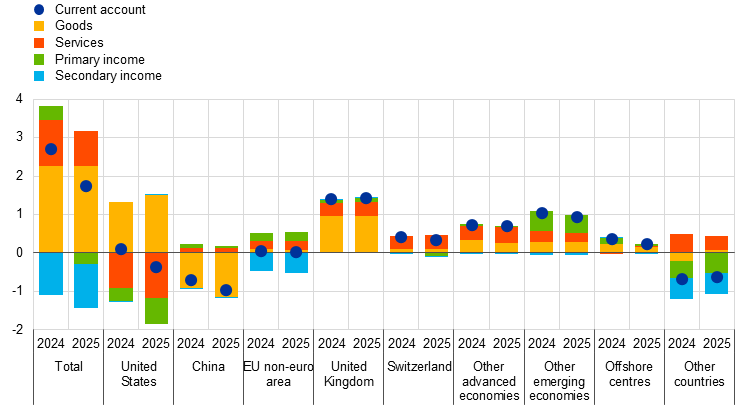
The decline in the euro area current account surplus in 2025 was primarily driven by developments in services trade and income flows, rather than by trade in goods. The goods surplus increased marginally, from 2.2% of GDP in 2024 to 2.3% in 2025. The narrowing of the current account surplus was thus largely due to changes in non-goods components, especially the shift in the primary income balance from a surplus of 0.4% of GDP to a deficit of 0.3% and the reduction in the services surplus from 1.2% of GDP to 0.9%.
The narrowing in the euro area current account surplus in 2025 was mainly due to developments vis-à-vis the United States and China (Chart B). The bilateral current account balance with the United States changed markedly, from a surplus of 0.1% of GDP in 2024 to a deficit of 0.4% in 2025, despite a larger goods surplus, reflecting larger euro area deficits in services and primary income. The euro area current account deficit vis-à-vis China widened from 0.7% of GDP in 2024 to 1.0% in 2025, in line with an increase in the goods deficit.
Chart B
Euro area current account balance: geographical breakdown
(percentages of GDP)
Source: ECB.
Notes: “EU non-euro area” comprises the non-euro area EU Member States and those EU institutions and bodies considered outside the euro area, such as the European Commission and the European Investment Bank. “Other advanced economies” includes Australia, Canada, Japan, Norway and South Korea. “Other emerging economies” includes Argentina, Brazil, India, Indonesia, Mexico, Russia, Saudi Arabia, South Africa and Türkiye. “Other countries” includes all countries not otherwise included in the chart as well as unallocated transactions.
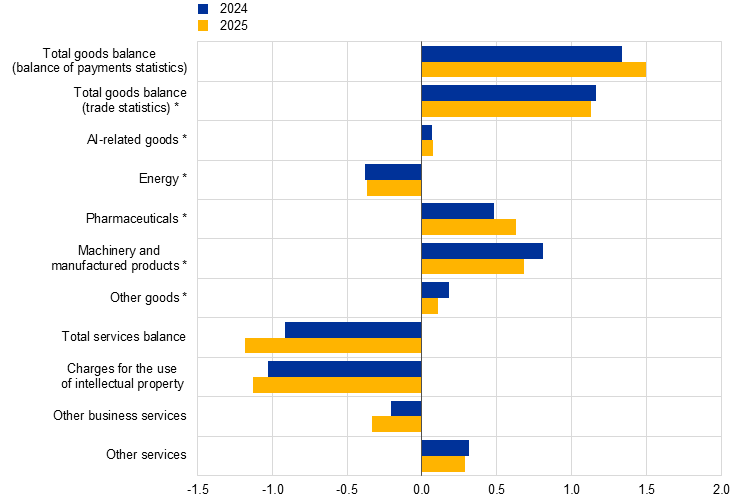
The switch from a surplus to a deficit in the euro area current account balance vis-à-vis the United States in 2025 is linked to the activities of US MNEs, whose euro area affiliates supported larger goods net exports, but generated increased services and income deficits. The increase in the goods trade surplus with the United States was primarily driven by exports of pharmaceutical products (Chart C), a sizeable part of which is linked to affiliates of US MNEs resident in the euro area, particularly in Ireland.[2] Notably, some of the export growth also reflected contract manufacturing arrangements, under which goods are recorded as euro area exports in balance of payments statistics even if they were not physically produced in the euro area, in line with international statistical standards. The production structures of euro area affiliates of US MNEs – in both the pharmaceutical and the technology sector – often rely on intellectual property owned by US parent companies. The corresponding charges are recorded as euro area services imports from the United States, while profits generated by US-owned affiliates contribute to primary (foreign direct investment) income payments. Estimates following Emter et al. (2025) suggest that around 40% of the euro area goods surplus with the United States in 2025 involved trade by euro area affiliates of US MNEs, while these companies accounted for almost 90% of the euro area deficit in services trade. Indeed, Ireland, which has a high share of US MNE activity, contributed 0.3 percentage points of GDP to the narrowing of the euro area surplus between 2024 and 2025, as its extra-euro area services and primary income deficits widened more than its goods surplus. At the same time, euro area exports to the United States of machinery and manufactured products declined in 2025, partly reflecting the impact of US trade tariffs announced in April 2025.[3] Overall, these developments show that the impact of tariffs and trade policy changes on the current account of the euro area cannot be assessed from trade in goods alone, particularly when trade is shaped by the supply chains and intellectual property arrangements of MNEs.
Chart C
Euro area trade balances vis-à-vis the United States
(percentages of GDP)
Sources: ECB, Eurostat and ECB staff calculations.
Notes: Data series marked with an asterisk (*) refer to international trade statistics, while other series refer to balance of payments statistics. The decomposition of the balance of trade in goods by product category follows the Standard International Trade Classification, Revision 3. “AI-related goods” reflects a basket of goods related to the construction and operation of AI data centre infrastructure and is estimated by ECB staff using Eurostat’s COMEXT data classified according to the Combined Nomenclature at 8-digit level (CN8) following the methodology in Waugh (2026).
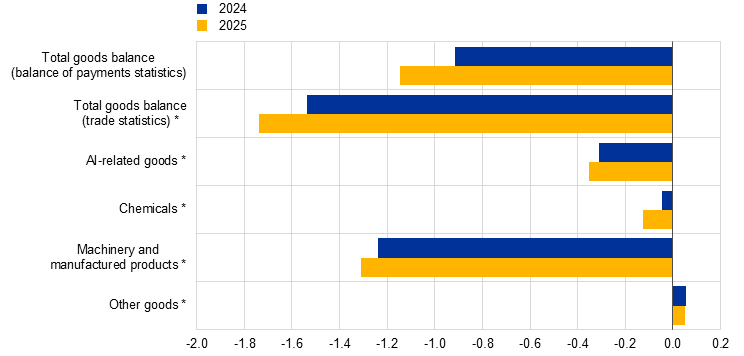
The second major factor behind the reduction in the euro area current account surplus relates to increasing competition from China. The widening of the euro area current account deficit vis-à-vis China was mainly due to a larger trade deficit in machinery and manufactured products (Chart D). The widening is consistent with China’s strong position in global supply chains, overcapacity against the backdrop of weak domestic demand, and non-market-based industrial policies.[4] These factors have depressed Chinese producer prices, thereby increasing China’s competitiveness in European markets, with import volumes surging by close to 10% in 2025. Rising competitive pressures, including from Chinese structural policies promoting self-reliance, in particular in medium and high-technology sectors, also weighed on the competitiveness of euro area exports to China, which declined by 0.3 percentage points of euro area GDP, and to third markets, where the euro area is increasingly losing export market shares to Chinese companies, particularly in medium-tech sectors.[5]
Chart D
Euro area balance of trade in goods vis-à-vis China
(percentages of GDP)
Sources: ECB, Eurostat and ECB calculations.
Note: See notes to Chart C.
Trade in AI-related goods had a relatively limited impact on the euro area goods balance, while it is likely that the increased adoption of AI-linked solutions by euro area customers contributed to the increase in euro area services imports. The euro area is a net importer of goods needed for the production and functioning of AI data centre infrastructure, with the deficit in such products increasing from 0.2% of GDP in 2024 to almost 0.3% in 2025, partly due to larger imports from China (Chart D).[6] AI-related goods accounted for around 13% of euro area goods imports and around 9% of exports in 2025, with the importance of such products gradually increasing in recent years.[7] AI adoption also affects the current account through imports of digital services, especially from the United States, as the deployment of AI systems also requires software, cloud computing capacity, data processing, model access and intellectual property. The rising deficits vis-à-vis the United States in charges for the use of intellectual property and other business services are consistent with increased payments for AI-enabling digital services.[8] China and Taiwan, on the other hand, are key suppliers of AI-related hardware.
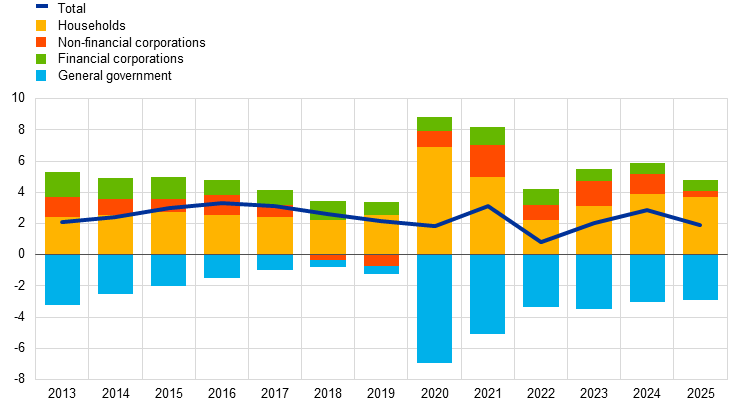
From a saving and investment perspective, the narrowing of the euro area external balance reflected a decline in net lending by non-financial corporations consistent with rising domestic investment needs (Chart E). Corporate gross saving fell from 12.3% of GDP in 2024 to 11.7% in 2025, while corporate gross capital formation rose from 12.0% to 12.3%. This reduced the corporate sector’s net lending.[9] In part, this points to a greater mobilisation of euro area saving towards domestic investment. As euro area digital investment accelerated in 2025, AI-related investment is likely to be part of this shift.[10] Some AI-related spending by euro area firms is recorded as domestic investment, thereby raising gross capital formation and reducing net lending. Other payments, such as recurring fees for model access, cloud computing and software licences, may instead be treated as intermediate consumption, reducing both corporate profits and saving.
Chart E
Euro area net lending/borrowing
(percentages of GDP)
Sources: ECB and Eurostat.
Note: “Households” includes non-profit institutions serving households.
The euro area current account surplus is expected to remain below its 2024 level over the medium term. The June 2026 Eurosystem staff macroeconomic projections for the euro area point to a further decline in the surplus to around 1.3% of GDP in 2026 in the wake of higher energy import prices as a consequence of the war in the Middle East, followed by a recovery to around 1.5% by 2028. Continued investment needs, including, for instance, those related to digitalisation, AI, defence and the energy transition, are expected to weigh on the external balance. Trade policy uncertainty, including in relation to US trade tariffs, and continued competitive pressures from China are also likely to remain important dampening factors for the euro area current account.
References
Al-Haschimi, A., Dvořáková, N., Le Roux, J. and Spital, T. (2025), “China’s growing trade surplus: why exports are surging as imports stall”, Economic Bulletin, Issue 7, ECB.
Amicucci, A., Gnocato, N., Gunnella, V., Lindemann, C., Merendino, A. and Montes-Galdón, C. (2026), “The impact of China’s industrial rise on the euro area”, Economic Bulletin, Issue 3, ECB.
Andersson, M., Colombo, S., Jarvis, V. and Morris, R. (2026), “From bricks to clicks: an assessment of euro area digital investment”, Economic Bulletin, Issue 2, ECB.
Emter, L., Fidora, M., Pastoris, F. and Schmitz, M. (2023), “The euro area current account after the pandemic and energy shock”, Economic Bulletin, Issue 6, ECB.
Emter, L., Fidora, M., Pastoris, F., Schmitz, M. and Schuler, T. (2025), “US trade policies and the activity of US multinational enterprises in the euro area”, Economic Bulletin, Issue 4, ECB.
Lane, P.R. (2026), “AI and the euro area economy”, keynote speech at the ECB-SAFE-RCEA International Conference on the Climate-Macro-Finance Interface (3CMFI), 23 March.
Rice, J. and Scally, J. (2026), “AI-related imports, modified investment and the data centre build-out”, Quarterly Bulletin, No 2, Central Bank of Ireland.
Schaefer, S., Gerland, L. and Tirpák, M. (2026), “Where do the costs of higher US tariffs fall?”, Economic Bulletin, Issue 2, ECB.
Waugh, M.E. (2026), “Trade in AI-Related Products”, NBER Working Paper, No 35053, April.
Legal Disclaimer:
EIN Presswire provides this news content "as is" without warranty of any kind. We do not accept any responsibility or liability for the accuracy, content, images, videos, licenses, completeness, legality, or reliability of the information contained in this article. If you have any complaints or copyright issues related to this article, kindly contact the author above.
