

Can Next-Generation AI Imaging Devices Accelerate Diagnostic Decision-Making?
This report, published by Towards Healthcare a sister firm of Precedence Research provides a concise and data-driven overview of the rapidly evolving AI imaging device market. It highlights key growth trends, technological advancements, and the factors shaping the market’s trajectory from 2025 to 2034.
Ottawa, Dec. 04, 2025 (GLOBE NEWSWIRE) -- The AI imaging device market is experiencing a period of rapid transformation as healthcare systems worldwide adopt next-generation tools to improve diagnostic precision, streamline workflows, and accelerate clinical decision-making. Between 2025 and 2034, the market is expected to grow substantially, driven by advances in deep learning, improved computing power, tele-radiology expansion, and the rising demand for early disease detection.
AI-enabled CT, MRI, ultrasound, X-ray, and PET systems are becoming integral components of modern hospitals and diagnostic centers, allowing clinicians to diagnose conditions earlier, automate image interpretation, and significantly reduce report turnaround times. As global healthcare moves toward digital integration, AI imaging devices are poised to become essential infrastructure for patient care delivery.
The Complete Study is Now Available for Immediate Access | Download the Sample Pages of this Report @ https://www.towardshealthcare.com/download-sample/6371
Key Takeaways
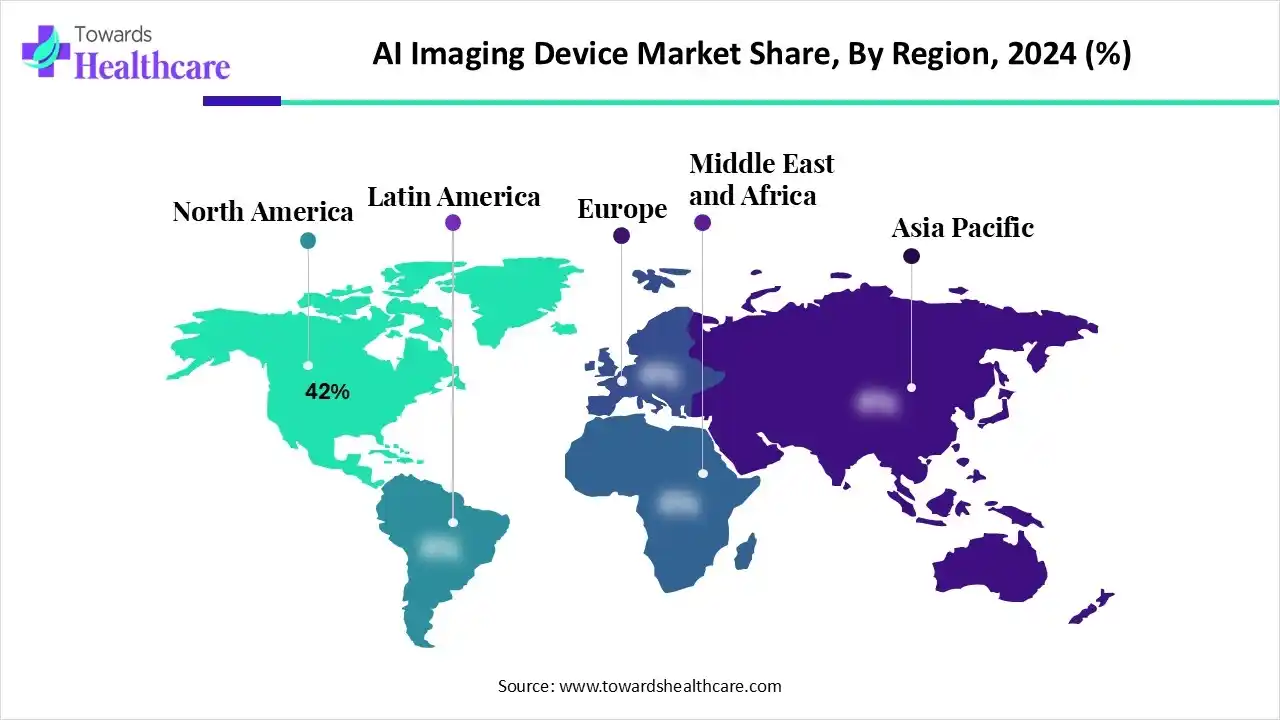
- North America dominated the AI imaging device market in 2024 with approximately 42% share.
- Asia Pacific is projected to be the fastest-growing region from 2025 to 2034.
- Computed Tomography (CT) held around 36 percent share of imaging modalities in 2024.
- Ultrasound is expected to witness the highest growth during the forecast period.
- Radiology accounted for close to 41 percent of application share in 2024.
- Oncology is expected to achieve the fastest growth trajectory through 2034.
- Deep Learning (DL) dominated with around 47 percent share in 2024.
- Hybrid AI models are expected to grow at the fastest rate over the forecast years.
- Cloud-based deployment represented 68 percent share in 2024 and remains the fastest-growing segment.
- Hospitals held around 45 percent market share in 2024.
- Diagnostic imaging centers will grow the fastest from 2025 to 2034.
Market Overview
How AI Imaging Devices Accelerate Global Healthcare Development
AI imaging devices are becoming central to modern diagnostics as healthcare systems struggle with increasing disease burdens, shortages of specialized radiologists, and the need for faster patient assessments. These systems combine advanced imaging hardware with powerful AI algorithms to analyze medical images with exceptional speed and accuracy. The integration of automated lesion detection, image optimization, segmentation, and predictive analytics reduces the time healthcare professionals spend on manual interpretation, thereby improving patient management and clinical outcomes.
Growing global awareness of chronic illnesses, such as cancer, cardiovascular disorders, neurological disease, and metabolic syndromes, further drives demand. Traditional imaging systems alone cannot handle the rising diagnostic load. AI imaging devices fill this gap by enabling physicians to identify subtle abnormalities earlier in disease progression, which can significantly improve treatment success rates.
The healthcare sector is undergoing a shift toward digital transformation. AI-enabled imaging devices are essential components of this shift, functioning as intelligent diagnostic tools that integrate seamlessly with electronic health records, cloud platforms, and telemedicine systems. As healthcare infrastructure in both developed and emerging markets continues to mature, AI-based imaging adoption is expected to accelerate dramatically.
Become a valued research partner with us - https://www.towardshealthcare.com/schedule-meeting
Major Growth Drivers
1. Rising Prevalence of Chronic and Lifestyle Diseases
Chronic diseases represent one of the most significant burdens on global healthcare. The rising incidence of cancer, diabetes, cardiovascular diseases, stroke, neurological disorders, and respiratory illnesses is creating pressure on healthcare systems to enhance diagnosis accuracy and reduce delays. AI imaging devices help clinicians detect diseases much earlier, enabling proactive treatment and improved patient outcomes. Increased imaging volumes for cancer screening and cardiovascular risk detection are particularly strong drivers for AI adoption.
2. Global Shortage of Radiologists
Many countries face a severe shortage of radiologists and skilled imaging professionals. Imaging workloads are growing, while radiologist numbers remain insufficient, especially in rural and underserved areas. AI-enabled imaging devices support radiologists by automating repetitive tasks, reducing manual interpretation time, and improving workflow efficiency. By reducing burnout and diagnostic errors, AI tools serve as valuable extensions of radiology teams.
3. Increasing Adoption of Digital Healthcare Ecosystems
Healthcare providers are integrating AI solutions with cloud platforms, telehealth services, electronic medical records, and remote diagnostic networks. These integrated digital ecosystems require AI-enabled imaging devices that can process and interpret data quickly. Growing digitalization in both hospitals and diagnostic centers significantly boosts market growth.
4. Advancements in Computing Power and Imaging Algorithms
The rapid evolution of GPUs, cloud computing, and edge computing has enabled AI algorithms to process larger and more complex datasets than ever before. High-resolution imaging, automated reconstruction, and multi-layered image analysis are now possible within seconds. These advancements are making AI imaging devices increasingly accurate, reliable, and scalable.
Market Trends
- AI-driven image reconstruction is reducing scan time, radiation exposure, and noise levels, especially in CT and MRI imaging.
- Cloud-based imaging platforms are enabling remote diagnostics, global collaboration, and real-time image sharing.
- AI tools are gaining acceptance in clinical workflows for triaging urgent cases and prioritizing high-risk patients.
- Radiomics is emerging as a powerful tool for advanced tumor characterization, treatment planning, and personalized medicine.
- AI imaging devices are increasingly used for mobile diagnostics in rural and remote regions.
Major Challenges
The greatest challenge facing the AI Imaging Device Market is ensuring data privacy and regulatory compliance. Healthcare facilities must safeguard sensitive patient data while integrating AI into their workflows. Concerns regarding algorithmic transparency, potential bias, and the reliability of prediction models often lead to hesitancy among healthcare stakeholders. Additionally, training AI models requires large, diverse datasets, which may be difficult to obtain due to privacy and consent requirements. Regulatory frameworks continue to evolve slowly, impacting the pace of adoption.
You can place an order or ask any questions, please feel free to contact us at sales@towardshealthcare.com
Regional Analysis
North America AI Imaging Device Market Trends:
North America accounted for the largest share of the AI imaging device market by 42% in 2024. The region’s technologically advanced healthcare systems, early adoption of AI-enabled diagnostic tools, and strong investment environment support market expansion. The growing need to detect cancer, heart disease, and neurological disorders at earlier stages drives demand for AI-enabled CT, MRI, and ultrasound systems.
United States:
The United States dominates the market due to its advanced imaging infrastructure, favorable reimbursement policies, strong funding for medical AI research, and rapid commercialization of AI imaging technologies. AI-enabled imaging devices are widely used in cancer centers, Level 1 trauma hospitals, and cardiac care units. The nationwide shift toward cloud-based diagnostics and large-scale tele-radiology networks is accelerating adoption.
Canada:
Canada is expanding AI imaging usage through digital healthcare initiatives such as virtual radiology networks and cloud-based diagnostic solutions. Hospitals across the country are adopting AI-enabled CT and MRI systems to address staffing shortages. Increased investment in rural diagnostics and remote imaging is significantly enhancing the market.
Asia Pacific AI Imaging Device Market Trends:
Asia Pacific is the fastest-growing regional market, supported by strong government initiatives, rising chronic disease prevalence, and rapid urbanization. Countries such as China, India, Japan, South Korea, and Thailand are investing heavily in AI-enabled diagnostic infrastructure to ensure faster and more accurate patient assessments.
China:
China is experiencing rapid adoption due to major government-led AI healthcare initiatives, expansions in hospital infrastructure, and a thriving AI-driven medical device industry. AI imaging tools are widely applied in lung disease diagnosis, cancer screening, stroke evaluation, and cardiology. The country is also building large-scale cloud-based medical imaging networks.
India:
India is emerging as one of the fastest-growing markets due to its combination of high disease burden, limited radiologist availability, and accelerating healthcare modernization. AI imaging devices are helping bridge gaps in both urban and rural healthcare settings. The expansion of diagnostic imaging chains, investments in radiology automation, and growth in tele-radiology platforms are driving the market.
Japan:
Japan’s aging population and high chronic disease rates are major drivers for adoption. Japanese hospitals are implementing AI-enabled MRI and CT platforms to improve diagnostic precision while reducing strain on medical staff. Strong local manufacturing capabilities and consistent government funding further strengthen the market.
Access the Dashboard: https://www.towardshealthcare.com/access-dashboard
Segmental Insights
By Imaging Modality
CT held 36 percent share of the market in 2024. AI-enabled CT systems improve detection of lung diseases, traumatic injuries, vascular disorders, and cancers. They reduce reconstruction time, lower noise, and improve clarity, making them essential for emergency medicine and critical care.
Ultrasound is expected to grow the fastest due to its portability, lower cost, safety, and increasing use in obstetrics, cardiology, liver health, and point-of-care diagnostics. AI supports automated detection of anatomical structures, fetal measurements, cardiac function, and organ abnormalities.
By Application
Radiology accounted for around 41 percent share in 2024. The increasing volume of CT, MRI, and X-ray scans requires advanced AI tools for triage, detection, and reporting. AI systems enhance diagnostic precision and reduce interpretation times, making them indispensable in radiology departments.
Oncology is projected to grow rapidly due to rising cancer incidence worldwide. AI imaging devices support early tumor detection, automated segmentation, therapy response monitoring, and radiomics-based predictive modeling. Hospitals are increasingly integrating AI into PET, CT, and MRI workflows for more personalized cancer treatment planning.
By AI Technology
DL dominated the market in 2024 with around 47 percent share. DL algorithms excel at analyzing large medical imaging datasets and identifying patterns that are difficult for human eyes to detect, thereby improving diagnostic accuracy.
Hybrid AI models combine ML, DL, rule-based systems, and clinical context, making them more transparent, explainable, and clinically trustworthy. They integrate imaging findings with medical history and lab results, improving diagnostic confidence.
By Deployment Mode
Cloud-based platforms held about 68 percent market share in 2024. They reduce hardware costs, enhance scalability, support tele-radiology, and provide rapid access to imaging data. Their strong cybersecurity frameworks and regulatory compliance make them ideal for large healthcare networks.
By End User
Hospitals represented approximately 45 percent of the market in 2024. AI-enabled CT, MRI, and ultrasound devices help hospitals handle increased patient loads, reduce reporting delays, and enhance clinical decision-making in emergency and specialized care.
Diagnostic Imaging Centers (Fastest Growing)
Diagnostic imaging centers are expected to grow fastest due to rising outpatient imaging demand. These centers are replacing older imaging systems with AI-enabled platforms to provide faster, more accurate diagnostics at lower costs.
Recent Developments
- March 2025: Siemens Healthineers launched AI-powered MRI acceleration software that enhances reconstruction speed and clarity.
- July 2025: Philips introduced AI-enabled CT 5300 and celebrated the installation of more than 1500 helium-free MRI systems globally.
- May 2025: GE HealthCare launched CleaRecon DL to improve CBCT image quality, receiving both FDA 510(k) clearance and CE mark.
- October 2025: RSNA Ventures partnered with Rad AI to advance innovation in radiology.
- May 2025: Oracle Health, Cleveland Clinic, and G42 launched a partnership to develop an AI-supported healthcare delivery platform.
Leading Companies in the AI Imaging Device Market
- GE HealthCare Technologies
- Siemens Healthineer
- Philips Healthcare
- Canon Medical Systems
- Fujifilm Holdings
- Samsung Medison
- Carestream Health
- United Imaging Healthcare
- Agfa-Gevaert Group
- Esaote SpA
- Butterfly Network
- HeartFlow Inc.
- Aidoc
- Zebra Medical Vision
- Infervision
- Lunit Inc.
- Deepwise AI Lab
- Caption Health
- Enlitic
Segments Covered
By Imaging Modality
- X-ray
- Computed Tomography (CT)
- Magnetic Resonance Imaging (MRI)
- Ultrasound
- Positron Emission Tomography (PET)
- Others
By Application
- Radiology
- Cardiology
- Oncology
- Neurology
- Orthopedics
- Ophthalmology
- Dental
- Others
By AI Technology
- Machine Learning
- Deep Learning
- Computer Vision
- Natural Language Processing
- Hybrid AI Models
By Deployment Mode
- On-Premise
- Cloud-Based
By End User
- Hospitals
- Diagnostic Imaging Centers
- Research and Academic Institutes
- Ambulatory Care Centers
- Others
By Region
- North America (United States, Canada)
- Asia Pacific (China, Japan, India, South Korea, Thailand)
- Europe (Germany, UK, France, Italy, Spain, Sweden, Denmark, Norway)
- Latin America (Brazil, Mexico, Argentina)
- Middle East and Africa (South Africa, UAE, Saudi Arabia, Kuwait)
Immediate Delivery Available | Buy This Premium Research @ https://www.towardshealthcare.com/checkout/6371
Access our exclusive, data-rich dashboard dedicated to the healthcare market - built specifically for decision-makers, strategists, and industry leaders. The dashboard features comprehensive statistical data, segment-wise market breakdowns, regional performance shares, detailed company profiles, annual updates, and much more. From market sizing to competitive intelligence, this powerful tool is one-stop solution to your gateway.
Access the Dashboard: https://www.towardshealthcare.com/access-dashboard
About Us
Towards Healthcare is a leading global provider of technological solutions, clinical research services, and advanced analytics, with a strong emphasis on life science research. Dedicated to advancing innovation in the life sciences sector, we build strategic partnerships that generate actionable insights and transformative breakthroughs. As a global strategy consulting firm, we empower life science leaders to gain a competitive edge, drive research excellence, and accelerate sustainable growth.
You can place an order or ask any questions, please feel free to contact us at sales@towardshealthcare.com
Europe Region: +44 778 256 0738
North America Region: +1 8044 4193 44
APAC Region: +91 9356 9282 04
Web: https://www.towardshealthcare.com
Our Trusted Data Partners
Precedence Research | Statifacts | Towards Packaging | Towards Automotive | Towards Food and Beverages | Towards Chemical and Materials | Towards Consumer Goods | Towards Dental | Towards EV Solutions | Nova One Advisor | Healthcare Webwire | Packaging Webwire | Automotive Webwire | Nutraceuticals Func Foods | Onco Quant | Sustainability Quant | Specialty Chemicals Analytics
Find us on social platforms: LinkedIn | Twitter | Instagram | Medium | Pinterest


Legal Disclaimer:
EIN Presswire provides this news content "as is" without warranty of any kind. We do not accept any responsibility or liability for the accuracy, content, images, videos, licenses, completeness, legality, or reliability of the information contained in this article. If you have any complaints or copyright issues related to this article, kindly contact the author above.
